The Human-in-the-Loop Data Analytics (HILDA) workshop provides a forum for researchers and practitioners to exchange ideas and results on how data management and analysis can be conducted with a deep awareness of the people who design, build, interpret, and are impacted by these processes. HILDA brings together researchers from the database systems, human–computer interaction, information visualization, data mining, and machine learning communities to explore the distinctive ways in which humans interact with data systems.
This year's theme, Collaborative Human–AI Data Analysis Workflows, emphasizes the growing need to design and understand data systems where humans and artificial intelligence, particularly large language models (LLMs) collaborate as partners. The success of LLMs highlights the critical role of human interaction in achieving meaningful, reliable, and context-aware outcomes. We invite submissions that study or enable such human–AI partnerships in data analysis pipelines, spanning data curation, exploration, visualization, interpretation, and decision-making.
Given that HILDA 2026 will be held in Bengaluru, India, a global hub for data-driven innovation, human-centered technology, and social impact, we particularly welcome work that explores human–AI collaboration in real-world, socially relevant, or resource-constrained settings. Topics such as fairness, inclusion, and cultural context in data systems are especially encouraged.
Proceedings
Proceedings for accepted papers are available in the ACM Digital Library. Individual paper links are also provided in the program below
Program
| 8:55 AM | Welcome and Setup | Kexin Rong (Georgia Tech) |
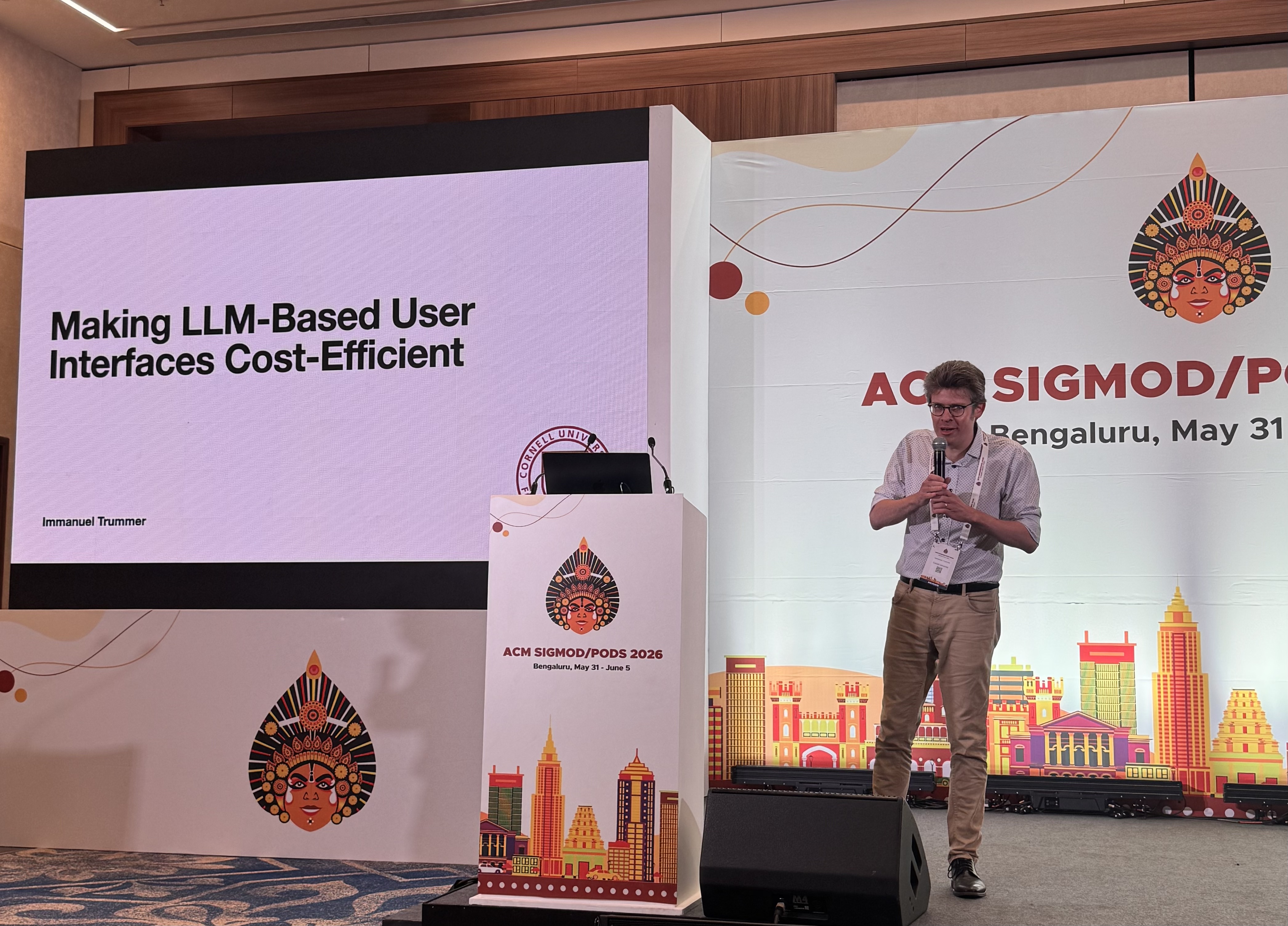
| 9:00 AM | Keynote by Immanuel Trummer: Making LLM-Based User Interfaces Cost-Efficient | |
| 10:00 AM | Towards More Realistic Natural Language Queries in Text-to-SQL Benchmarks | Carsten Binnig (TU Darmstadt) |
| 10:15 AM | FlowPilot: A Suggestion System for Designing Scientific Workflows | Mahdi Esmailoghli (HU Berlin) |
| 10:30 AM - 11:00 AM | Coffee Break | |
| 11:00 AM | AURA: Agentic AI for Unified Reliability Modeling and Annotation Aggregation | Subhodeep Ghosh (NJIT) |
| 11:15 AM | LakeAgents: An LLM-Based Multi-Agent Framework for Tabular Data Augmentation | Fatemeh Nargesian (U of Rochester) |
| 11:30 AM | SmartRabbit: An Interactive Query Processor | Pratyoy Das (UC Irvine) |
| 11:45 AM - 1:30 PM | Lunch Break | |
| 1:30 PM | Keynote by Aditya Parameswaran: Reimagining the Role of Humans in LLM-Powered Data Systems | |
| 2:30 PM | Increment: Scented Navigation for Incremental Knowledge Graph Query Construction | Dylan Wootton (MIT) |
| 2:45 PM | Data-Semantics-Aware Recommendation of Diverse Pivot Tables | Whanhee Cho (U of Utah) |
| 3:00 PM - 3:30 PM | Coffee Break | |
| 3:45 PM | Interpretable Attribute Discretization | Eugenie Lai (MIT) |
| 4:00 PM | Reqo: A Comprehensive Learning-Based Cost Model for Robust and Explainable Query Optimization [Video] | Baoming Chang (University of Ottawa) |
| 4:15 PM | Closing Remarks | Vidya Setlur (Tableau Research) |
HILDA 2026 Keynote Talks
Our exciting program will feature the two invited keynote speakers to talk about the challenges of human-data interaction.
|
|
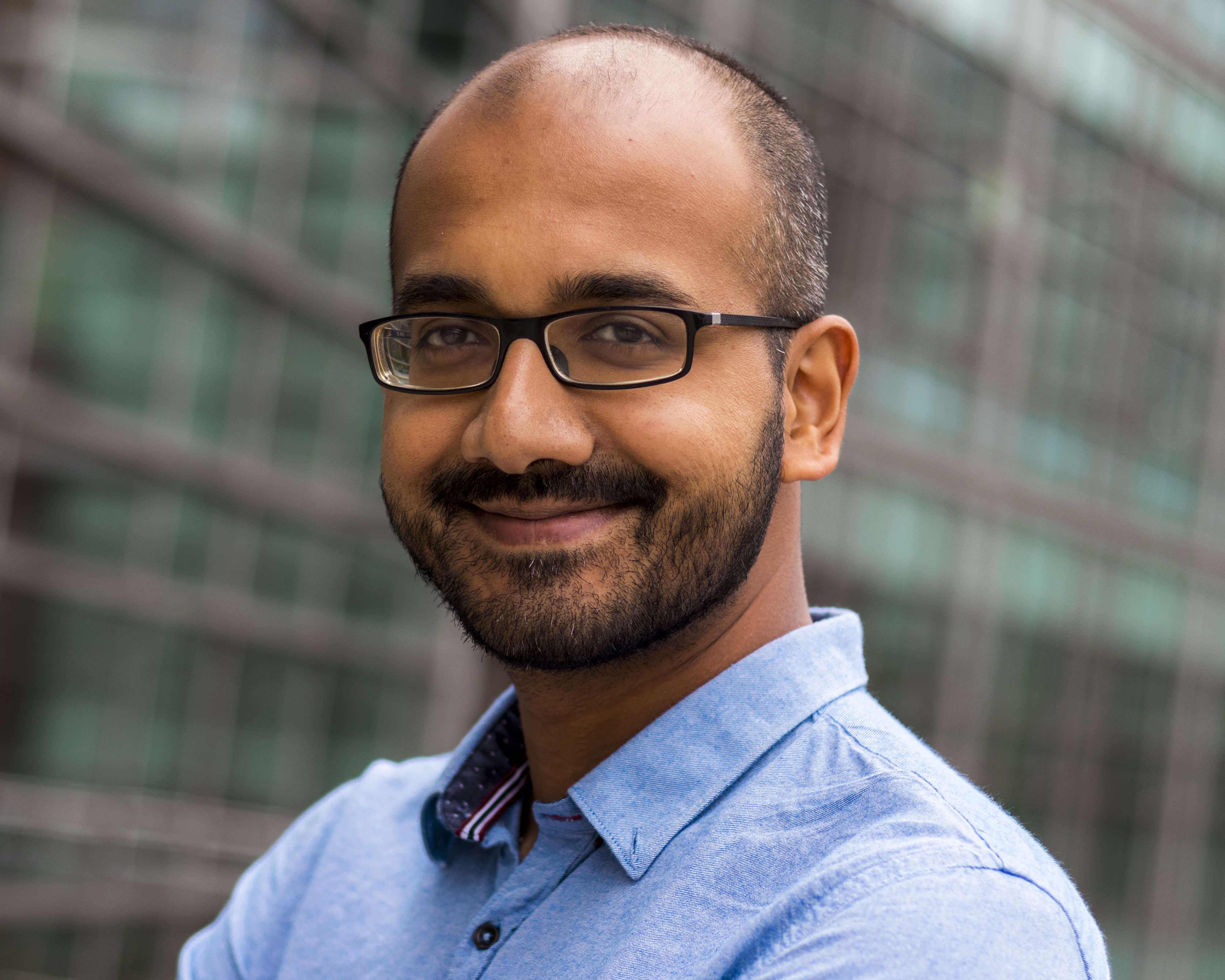
Title: Reimagining the Role of Humans in LLM-Powered Data Systems Aditya Parameswaran, Associate Professor, University of California, Berkeley Speaker Bio: Aditya Parameswaran is an Associate Professor in Computer Science at UC Berkeley, and a co-director of the EPIC Data Lab. Aditya has published 100+ papers in top-tier venues in data management, human-computer interaction, and visualization, with multiple best paper awards. Multiple open-source tools developed in his group have received thousands of GitHub stars (including Modin, Lux, IPyFlow, DocETL)---and have been downloaded tens of millions of times overall across a spectrum of industries. His research was commercialized as a startup, Ponder, in 2021, where he served as Co-founder and President, before its acquisition by Snowflake. Aditya has received the Alfred P. Sloan Research Fellowship, VLDB Early Career Award, the NSF CAREER Award, the TCDE Rising Star Award, along with other recognitions. |
|
|
Title: Making LLM-Based User Interfaces Cost-Efficient Immanuel Trummer, Associate Professor, Cornell University Speaker Bio: Immanuel Trummer is an associate professor of computer science at Cornell University. His research focuses on making data analysis more efficient and more user-friendly. His papers were selected for "Best of VLDB", "Best of SIGMOD", and the CACM Research Highlight Award. He received an NSF CAREER grant for his work on database tuning via LLMs and multiple Google Faculty Research Awards. |

What to submit
We welcome both traditional research papers and exploratory or non-traditional contributions, including early-stage or in-progress work, experience reports, reflections, open problems, research visions, and speculative ideas. Submissions should present work or perspectives that are likely to spark engaging discussion at the workshop or that the authors explicitly seek feedback and mentoring on. We encourage contributions that propose new designs for human-centered data management systems, empirically study how people interact with data systems, or draw from perspectives across database systems, HCI, visualization, machine learning, industry practice, and organizational or social contexts.
Example topics of interest include, but are not limited to:
- Human–AI and human–LLM collaboration in data analysis workflows
- Interactive query refinement, exploration, and visualization
- Human-assisted data integration, labeling, and cleaning
- Perception-aware and context-aware data processing
- Cognitive models of data understanding and decision-making
- Fairness, ethics, and accountability in data-driven systems
- Provenance, explanation, and interpretability in AI-assisted data systems
- Human-in-the-loop learning, debugging, and evaluation
- Crowd-powered and community-driven data infrastructure
- Design and evaluation of data systems for social good, sustainability, and inclusion
Mentoring-Centered Workshop Format
HILDA 2026 continues its mentoring-focused format introduced in 2022. Authors of accepted papers can opt in to a mentoring program, where they will be paired with a program committee member for feedback and guidance before the camera ready submission. This model aims to foster constructive discussion, skill development, and interdisciplinary collaboration, particularly supporting early-career researchers and new contributors to the HILDA community.
All accepted papers will be presented at the workshop, which will emphasize discussion and engagement over static presentations. The workshop will also feature invited keynote speakers from the visualization, AI ethics, and human-centered computing communities to broaden the interdisciplinary dialogue.
Review and Mentorship Process
Reviews are single-anonymous. Each submission will be reviewed by at least three reviewers, where the reviewers will assess:
- Fit with HILDA's scope and mentoring model
- Quality and clarity of the work
- Potential for future impact and discussion
Authors of accepted papers can opt in to the mentoring program and will be paired with a program committee member. Authors and mentors may withdraw from a pairing without repercussions in the case of unforeseen conflicts, and the program chairs will assign an alternative mentor when possible.
Submission Instructions
- Paper length: 4–6 pages (excluding references)
- Format: SIGMOD 2-column ACM Proceedings format
- Templates: LaTeX or Word templates. Overleaf users should use the 2-column ACM SIG Proceedings template.
- Submission site: Microsoft CMT
Submissions should reflect the current state of the research and include a brief discussion of limitations, open challenges, or questions the authors would like feedback on from mentors and the HILDA community.
The Microsoft CMT service was used for managing the peer-reviewing process for this conference. This service was provided for free by Microsoft and they bore all expenses, including costs for Azure cloud services as well as for software development and support.
Important Dates
- Workshop Date: June 5, 2026
- Submission: March
2330, 2026 (AOE) - Notification of outcome: April 22, 2026
- Camera-ready due: May 17, 2026 (AOE)
Workshop Chairs
- Kexin Rong (Georgia Institute of Technology)
- Anna Fariha (University of Utah)
- Vidya Setlur (Tableau Research)
Program Committee
- Aamod Khatiwada (Microsoft)
- Andra Ionescu (KTH Royal Institute of Technology)
- Avigdor Gal (Technion - Israel Institute of Technology)
- Cindy Xiong Bearfield (Georgia Institute of Technology)
- Danyel Fisher (Independent Consultant)
- Enrico Bertini (Northeastern University)
- Fatemeh Nargesian (University of Rochester)
- George Fletcher (Eindhoven University of Technology)
- Grace Fan (New York University)
- Jean-Daniel Fekete (Inria)
- Kaustav Bhattacharjee (New Jersey Institute of Technology)
- Marco Angelini (University of Rome "La Sapienza")
- Roee Shraga (Worcester Polytechnic Institute)
- Romila Pradhan (Purdue University)
- Senjuti Basu Roy (New Jersey Institute of Technology)
- Stavros Sintos (University of Illinois Chicago)
- Yuval Moskovitch (Ben Gurion University)
- Zafeiria Moumoulidou (Meta)
- Zhengjie Miao (Simon Fraser University)
Steering Committee
- Carsten Binnig (TU Darmstadt)
- Juliana Freire (New York University)
- Aditya Parameswaran (University of California, Berkeley)
- Arnab Nandi (Ohio State University)
Contact
For questions, please email the workshop chairs directly.